The Greene Township, Pike County, Board of Supervisors have adopted Ordinance #99 – Short-Term Rental Ordinance at the regular meeting on November 2, 2022.
Ordinance #99 regulates short-term rentals within the township and establish penalties for violations. A copy of the ordinance is available for review below.
The Greene Township, Pike County, Board of Supervisors have adopted Ordinance #101 – Amending the Short-Term Rental Ordinance at the regular meeting at 7:00pm on December 6, 2023 at the municipal building, 198 Brink Hill Road, Greentown, PA. Ordinance #101 amends Ordinance #99 which currently regulates short-term rentals within the township and establishes penalties for violations. A copy of the amended ordinance is below.
At the regular meeting on November 1, 2023, the board of supervisors took official action to contract with Bureau Veritas for enforcement of Ordinance #99 – Short-Term Rental Ordinance and Ordinance #101 – Amending Short-Term Rental Ordinance.
The board of supervisors have adopted Ordinance #101 which amends portions of Section 12 of the Short-Term Rental Ordinance. The original ordinance is below for comparison.
Three separate checks should be submitted per the following: Payable to Bureau Veritas = $500 Payable to Greene Township = $200 Payable to Greene Township = $100
Application
If you operate a short-term rental property in Greene Township, Pike County, PA, please submit an application and applicable fees to:
Greene Township Short-Term Rental Application 198 Brink Hill Road Greentown, PA 18426 Lourdes Aponte Email: lourdes.cardinez@bureauveritas.com
Each Short-Term Rental Unit must be renewed and the annual fee paid before February 15th of each calendar year, and at any time when any of the conditions of the rental which are governed by this Ordinance are changed.
If you are a property owner in Greene Township and would like to submit a complaint about a Short-Term Rental property, please submit a Request for Action Form.
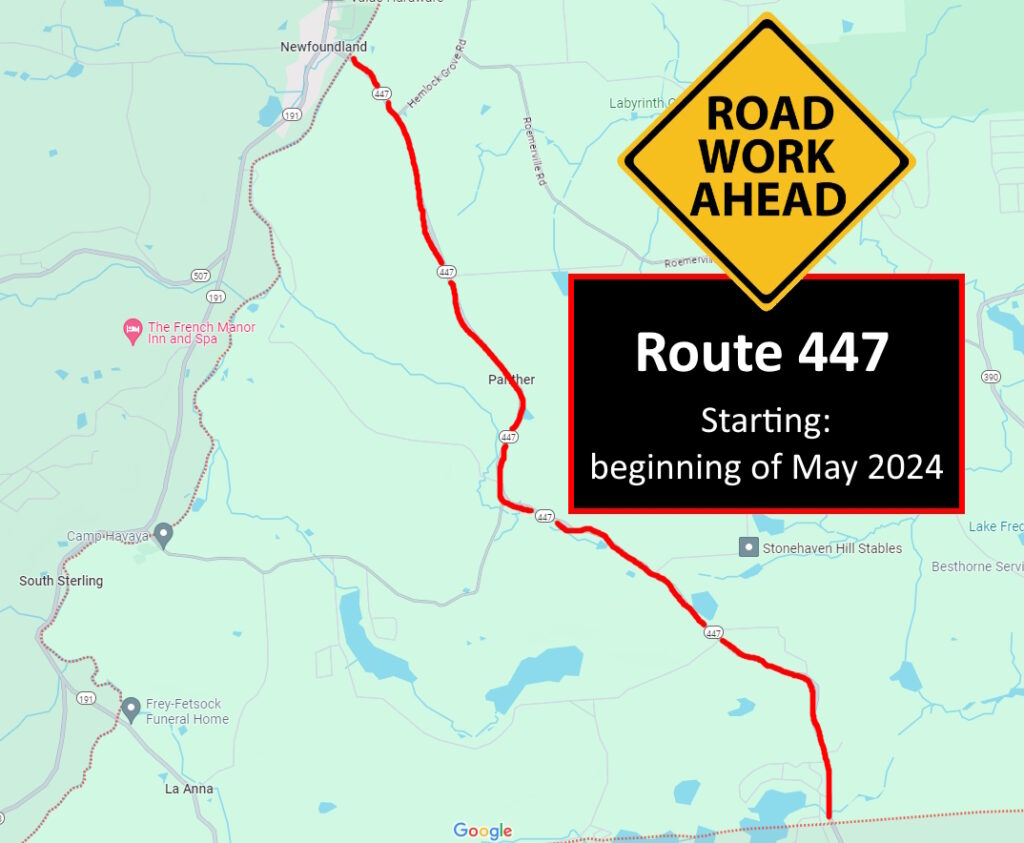
Roadwork is scheduled to begin on Route 447 in Greene Township in the beginning of May 2024.
Please be advised of possible road restrictions and/or closures during construction.
Project Limits: Pike County, Greene Township, State Route 447 (Panther Road) Narrative: Resurfacing on State Route 447 (Panther Road) from Pike/Monroe County Line to Wayne/Pike County Line in Greene Township, Pike County.
This is a state owned road; therefore, Greene Township has no authority over this project. This is for informational purposes only. Please contact PennDOT with questions and/or concerns regarding Route 447.
Greene Township, Pike County, Pennsylvania will hold the annual Clean Up Day on Saturday, May 18, 2024 from 8:00am-2:00pm at the municipal building – 198 Brink Hill Rd., Greentown, PA 18426.
The township will not accept anything outside of the scheduled hours of 8am-2pm on May 18th
You must be a Greene Township resident. Please keep in mind that some of Greentown is in Palmyra Township. To verify you are a Greene Township resident, please check your tax bill, voter registration, or the Pike County GIS Map which can be accessed here: GIS Map. Please bring proof of residency, as you may be asked for it.
We cannot accept the following: hazardous materials, daily garbage, construction materials (shingles, lumber, bricks, etc.). Please check the flyer for a list of hazardous materials.
Registration Open for Pick Up the Poconos Spring Cleanup Volunteers needed for region-wide effort on Saturday, April 20
March 7, 2024 – Celebrate Earth Day early this year by spending time caring for the environment. The Pocono Mountains Visitors Bureau (PMVB) is seeking volunteers for its next region-wide litter pick-up day on Saturday, April 20, 2024, from 9:30 a.m. to 12:30 p.m. (rain or shine). The Pick Up the Poconos Spring Cleanup is just one component of the PMVB’s “Pick Up the Poconos” campaign, which has resulted in nearly 38,000 bags of trash being picked up and properly disposed of.
Individuals and groups interested in helping the cause can fill out the Volunteer Form or Group Sign-Up Form located at PickUpthePoconos.com. The deadline to register is Wednesday, April 10, 2024, by 5:00 p.m.
There are nearly 20 participating locations across Wayne, Pike, Monroe, and Carbon counties for volunteers to choose from. Private cleanups led by various community groups are also planned in conjunction with this initiative. Volunteers will receive supply kits on the day of the event consisting of trash bags, gloves, safety vests, and other supplies.
After the cleanup, volunteers are invited to the annual Earth Day Celebration at Pocono Organics from 10:30 a.m. to 3:30 p.m. for exclusive access to door prizes, complimentary refreshment vouchers, educational activities, and more. The event is hosted by Monroe County Waste Management Authority, Pocono Organics, and the Pocono Mountains Visitors Bureau.
Help spread the word about the Pick Up the Poconos Spring Cleanup by sharing the event on Facebook (HERE).
For resources and safety tips about picking up litter, visit PickUpThePoconos.com.
Pocono Mountains visitor information is available online at PoconoMountains.com or by phone at (570) 421-5791. Follow @PoconoTVNetwork on X to stay current with up-to-date information. Established in 1934, the Pocono Mountains Visitors Bureau is a private, non-profit membership organization. The PMVB is the official destination marketing organization for the four counties of Wayne, Pike, Monroe, and Carbon in Northeastern Pennsylvania.
It’s easy for taxpayers to say, “I pay my taxes, I want MY road fixed!” But, do you know what your taxes go towards?
Your local government starts at the municipal level. Run by a three member board of supervisors who are elected into office by the electors of the municipality, this board makes all decisions on behalf of the township.
So, what kind of decisions is your board of supervisors responsible for? Some aspects of municipal government are:
Road Maintenance
The township roadcrew is only responsible for township owned roads. State owned roads are maintained by the state (PennDOT) and privately owned roads (such as in an HOA) are maintained by the property owners. To find a list of township owned roads, click here
Land Use
This includes things like combining two lots into one lot, subdividing one lot into numerous lots, and building commercial structures. This is governed by the Subdivision & Land Development Ordinance, which can be found here
Building Inspections
The International Building Code is enforced at the local level. Our township contracts a third party building inspection company, Bureau Veritas, to perform inspections and issue permits in the township. More information can be found here
Sewage Enforcement
Along the lines of building inspections, certain regulations must be followed for installing and maintaining a septic system. The township’s Sewage Enforcement Officer handles this. His information can be found here
Enforcement of Local Laws
Local laws, also known as ordinances, govern the health, safety, and welfare of the township residents. The township adopts ordinances to regulate junkyards, dangerous structures, short-term rental properties, outdoor fires, and signs. These laws are meant to protect the residents and provide a safe community. They can be found here
“Where does the township get funds from?”
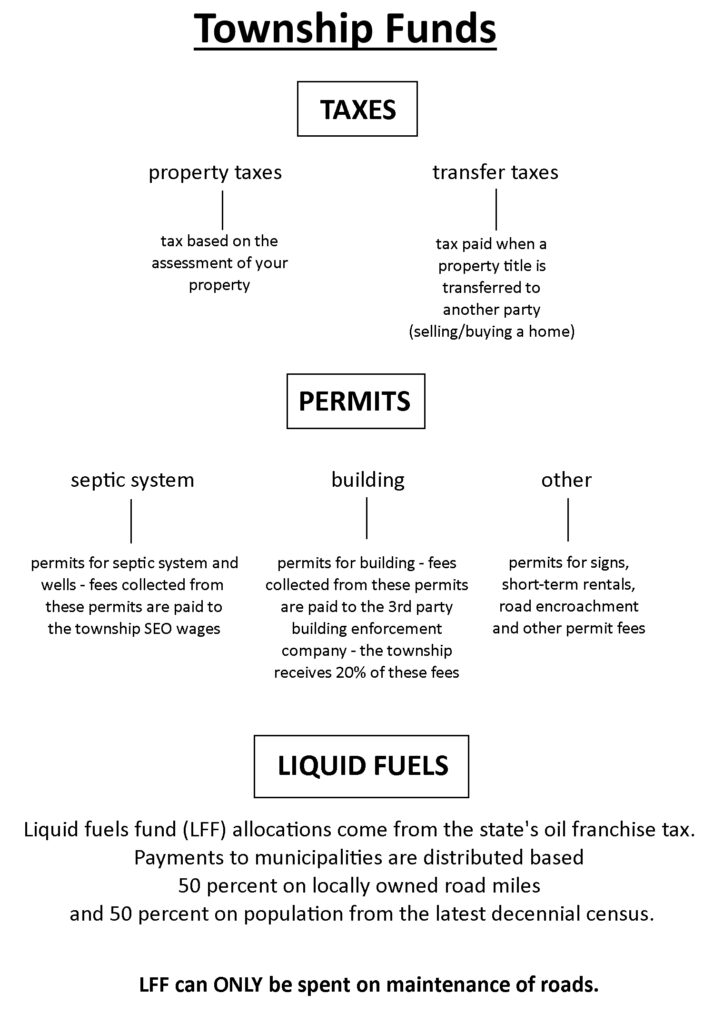
In order for the board of supervisors to properly complete their responsibilities, funds are required. Funding for townships comes from many different sources, the main source being taxes.
Taxes
Property taxes (tax based on the assessment of your property) and transfer taxes (tax paid when a property title is transferred to another party) are the main sources of income for townships.
Permits
Fees for permits, such as septic system/well permits and building permits generate income. However, this income is directly used to pay wages for the SEO (Sewage Enforcement Officer) and the third-party building department.
Liquid Fuels
LFF are provided by the state to the township. These funds can ONLY be used on road and vehicle maintenance (learn more about these funds).
The township receives funds from some other sources, too. These include:
Fines and forfeits which come from the District Court Magistrate and Probation Fines.
Interest on township funds that are deposited into interest bearing accounts such as money markets and CDs.
State payment in lieu of taxes which comes from state owned land.
“So use the Liquid Fuels Fund (LFF) to pave my road.”
With all the funds received by the township, you may wonder where they all go. For example, in 2023 the township received $169,255 from LFF for the maintenance of the twenty-two roads totaling 34.65 miles that are owned by Greene Township. In order to maintain the road equipment, trucks, and other machinery, $38,165 was spent. Another $32,976 was spent on material to repair and maintain the actual roads by filling potholes, fixing washouts, and spreading cinders. $14,512 was spent for fuel to operate the equipment.
After deducting all the expenses, the township was left with approximately $83,600 of liquid fuels money at the end of 2023.
The most recent paving project the township did was to pave a portion of Valley View Road and a portion of Saw Mill Road in 2021. The paved area totalled about 1 mile of road and cost $186,358. Since then, material and expenses have increased substantially.
Therefore, the funds received from Liquid Fuels is not enough to cover the current expense of paving even 1/2 mile of road.
Bridges
In addition to road maintenance, the township is also responsible to maintain numerous bridges in the area. Township owned bridges include Lake Russell Road Bridge, Saw Mill Road Bridge, Mozzette Road Bridge, among others. Many of these bridges are in severe condition and require repair or replacement. Click here to see the bridge conditions in our township.
Lake Russell Road Bridge was just repaired (not replaced) in 2023 and cost approximately $268,000.
You may notice that some bridges are restricted to weight limits and/or one lane. This is because these bridges are in dire need of replacement. The past few years, the township has applied for grant money to try to get some of these bridges replaced. The estimated cost to replace Saw Mill Road Bridge and Mozzette Road Bridge is $3,000,000 (yes, that’s 3 MILLION). So far, we have not been awarded any money.
Even if we do get awarded money, many grants require the township to match a portion of the cost and pay other expenses that are not covered under the grant money, such as engineering and administration costs. And many grants do not award the full amount requested. So, in an effort to have the substantial funds required for bridge repairs and replacements, the township must keep saving money to eventually complete these projects.
“So what about my taxpayer dollars?”
Other sources of income for the township may be used to pave roads. However, these funds must also be allocated for general operating expenses, too. The township office is open to the public four days a week. A secretary and treasurer perform the duties of paying bills, depositing funds, answering resident inquiries, accepting land development submissions, completing employee paperwork, ordering supplies, and many other tasks.
The road work that’s required is completed by a road crew. Greene Township’s road crew currently consists of three full time employees and one part time employee.
Other operating expenses include the cost of keeping the township facilities running. Heating, electric, internet and phone, postage, website, solicitor, park maintenance, and many other fees are required to keep the township operating.
Between the general municipal operating costs, payroll, insurance on township buildings and equipment, there are a lot of expenses which are paid for with taxpayer dollars.
Other Township Expenses
Other expenses that are the responsibility of the township:
Workers’ Compensation Insurance for volunteer fire companies – Promised Land Volunteer Fire Company & a portion of Greene-Dreher Volunteer Fire Company.
Clean Up Day – in 2023, the annual clean up day for township residents cost approximately $5,742. The fees paid by residents who participated generated only $2,785, leaving an almost $3,000 gap.
Memberships – memberships which provide resources and training to township officials and employees, such as the membership to the Pennsylvania State Association of Township Supervisors (PSATS).
Tax Collector – the tax collector receives 3.5% compensation for all taxes collected.
Engineering – certain road work requires a licensed engineer to review.
Advertising – the township legally must advertise meetings and other requirements in a paid newspaper of general circulation.
“So how do we get more funding?”
There are two ways to increase township funds:
Raise Taxes
Lower Expenses
DID YOU KNOW? – Taxes have not been raised in Greene Township in 16 years!
The quickest way to increase revenue to fix roads and pay expenses is to raise taxes. However, all of the township supervisors throughout the past 16 years have not done so. Raising taxes is a last resort, as the supervisors strive to keep them affordable.
Lowering expenses is another way to keep funds that are required. Many steps have been taken recently to try to lower township expenses. Energy efficient windows were installed in the meeting room/offices, heating oil quotes are received from numerous suppliers to ensure the lowest price, insurance was switched to a company with a lower premium, and other cost effective implementations.
The Bottom Line
While the township does plan to eventually pave and repair all roads and bridges, it is a long-term goal. Each year a budget is developed and adopted to allocate funds to all areas required. While the township budget is available for inspection before it’s adopted (click here), residents are also encouraged to attend budget meetings, and all other township meetings.
…the electors of each township shall elect three supervisors, three auditors and one tax collector. No person shall at the same time hold more than one elective township office.
…at each municipal election, the electors of each township shall elect one supervisor to serve for a term of six years from the first Monday of January after the election.
Greene Township, Pike County, Pennsylvania is a township of the Second Class. We have a 3 member board of supervisors who serve overlapping 6 year terms (visit the home page of the website to see the current board of supervisors). To serve as a supervisor, you must have resided in the township for at least 1 year, be at least 18 years old, be registered to vote, and continue to reside in the township.
The electors of the township are responsible for electing the board of supervisors. There are eligibility requirements for voting in Pennsylvania. They can be found here.
First Time Voters
If this is your first time voting in Pennsylvania, you may be confused about what to bring, or where to go to vote. Greene Township, Pike County’s voting location is the Hemlock Grove United Method Church located at 491 Roemerville Rd, Greentown, PA 18426. The polls are open from 7:00am-8:00pm. For more information on what to bring, click here.
How to Register to Vote, or find Elections Information
The Pike County Elections Office maintains and controls all activities relating to Voter Registration and Elections under the supervision of the Pike County Board of Elections.
Nadeen Manzoni – Director 506 Broad St. Pike County Administration Building Milford, PA 18337-1535 (570) 296-3426 • nmanzoni@pikepa.org
There are many homeowners associations, private communities and developments in Greene Township, Pike County. These include organizations that make and enforce rules and regulations in regards to what property owners can and cannot do with their properties. Upon purchasing a property on a private road, the property owner becomes a part of that organization and usually is required to pay dues. Generally, dues go towards road maintenance and any other facility upkeep that may be included.
Any road that is not owned by the township or the state is considered a private road and is paid for and maintained by those who own property on that road.
Click here to view a map of township and state owned roads. Any road not on this list is a privately owned road and homeowners are responsible for maintenance.
Residential Developments in Greene Township, Pike County, PA
Greene Township has numerous residential developments located within the municipality. In January 2010, Pike County Office of Community Planning put together a list of these developments for the county. Click below to view Greene Township’s portion of this list.
When owning a home or property in a development, an annual fee is usually due to maintain the community. The fee can range from a couple hundred dollars to thousands of dollars, depending on what is offered in the development and how many homes are a part of it.
Usually, the fees includes things like road maintenance, snow/ice removal, garbage pick up, amenity maintenance (such as a community pool, tennis court, playground, etc.) and security.
Pros & Cons of owning in a development.
There are many upsides to owning in an HOA or development. These include: neat, well-maintained properties, more stable property value due to consistent appearance of homes, access to exclusive amenities, assistance in resolving property-related disputes with neighbors.
However, some may not want to live in a development due to the restrictions they impose. Some HOAs may have restrictions on home colors, number of pets, putting up signs in your yard. The fees may also cause budget issues.
For more information on dues, bylaws and other information regarding developments, you would need to contact the development itself. The township does not keep contact information for developments.
Please follow this post for updates on bridge closures in the township.
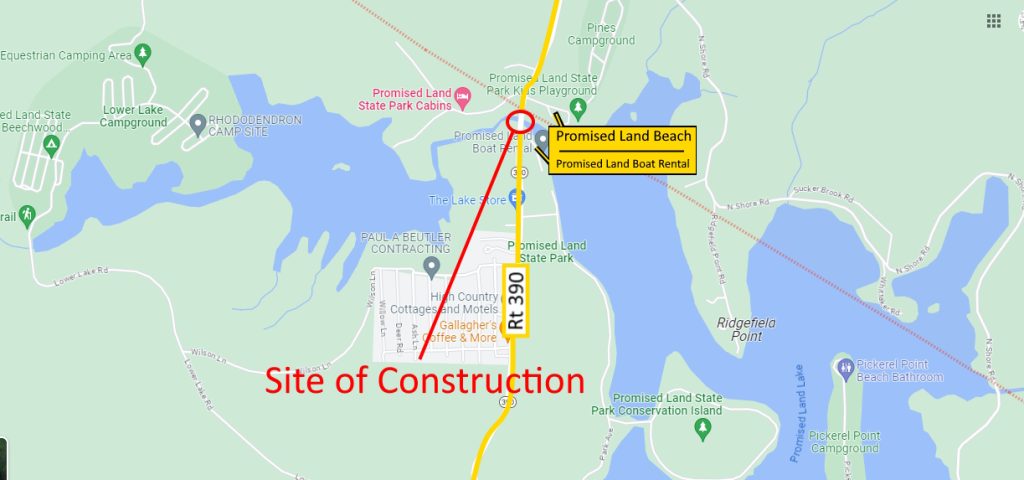
Rt 390 Bridge in Promised Land State Park
⚠️UPDATE – October 23, 2023: According to PennDOT’s report, work can begin 11/20/2024 (Estimated) with the completion date of 09/13/2026 (Estimated) ⚠️
The bridge located on Rt 390 in Promised Land State Park will be undergoing construction. Traffic will be maintained via a temporary, single lane so a detour will not be required. The project is scheduled to be started at the end of 2023 and continue through 2025.
More information can be found by zooming into the location on PennDOT’s map – Click here
❗️❕UPDATE – Apr 27: Construction has begun on Lake Russell Road Bridge and is expected to conclude in approximately 6-8 weeks. The bridge will be one lane, with the detour in place at times. ❗️❕
⚠️📣UPDATE – Apr 4: The construction company is experiencing delays sourcing the studs for the bridge repair work; therefore the start date has been pushed back. No start date has been provided at this time.
UPDATE – Feb 20: Due to material supplies, the project will start in late March, early April.
UPDATE – Feb 6: Construction start has been pushed back to the end of this week, or the beginning of next week. The project is estimated to take 6-7 weeks
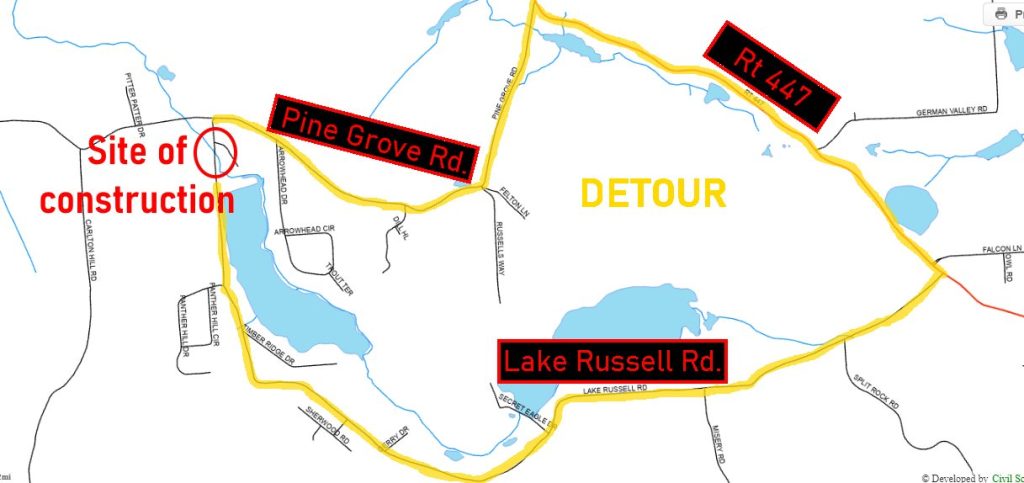
Starting the week of February 6th, Lake Russell Road bridge over Freeling Run will be undergoing repairs. Lake Russell Road will be CLOSED at the site of construction. See map for detour.
Pine Grove Road bridge over Wallenpaupack Creek, near Rt 191
BRIDGE OPEN
Pine Grove Road bridge over Wallenpaupack Creek, near Rt 191 will be CLOSED, starting March 23, 2023 through August 2023 for a bridge repair project. A DETOUR WILL BE IN PLACE
For more information, visit PennDOT’s Projects website: https://gis.penndot.gov/paprojects/PAProjects.aspx then click on “Construction Projects” then click on “View Projects” then select “Pike” County. You can zoom into the location and click on it to see more information.
Living in Northeastern Pennsylvania, it’s common to see dead deer along the side of the roads. This unfortunate occurrence can lead to other animals being in the road to feed off it, foul smells, road obstructions and other inconveniences. Sometimes they can be there for days or even weeks. So, who is responsible for removal?
PennDOT removes dead deer from state roads. You can report a dead deer by calling 1-800-FIX-ROAD and giving the location of the carcass.
If the deer is not on a state road, but is on a township or a private road, you can call the Pennsylvania Game Commission’s Northeast Region at 570-675-1143.
Click here to view what roads are state owned and what roads are township or private: Map of Pike County Roads
Many people don’t want to see an animal go to waste, so the game commission allows Pennsylvania residents to pick up deer and turkey for consumption purposes. A permit must be obtained within 24 hours from the Pennsylvania Game Commission’s Region Office which serves the county where the animal is located. For more information on this, click here.
Are you new to the area, or in need of a business for a home related project and don’t know who to call? We’ve got you covered!
There are many local businesses that specialize in home related projects. From building new structures, to removing trees on your property, it’s important to call a reliable business. We’ve put together a list of local home related businesses for your convenience.
*Please note: Township employees cannot recommend businesses. This is a general directory for informational purposes. We are not affiliated with any businesses on this list. Business owners are responsible for their own licensing and insurance.
If you own a local business that’s home related and would like to be added to this directory, please email your business name, phone number, website, location and services to secretary@greenetownship.org





 UPDATE – Feb 20: Due to material supplies, the project will start in late March, early April.
 UPDATE – Feb 6: Construction start has been pushed back to the end of this week, or the beginning of next week. The project is estimated to take 6-7 weeks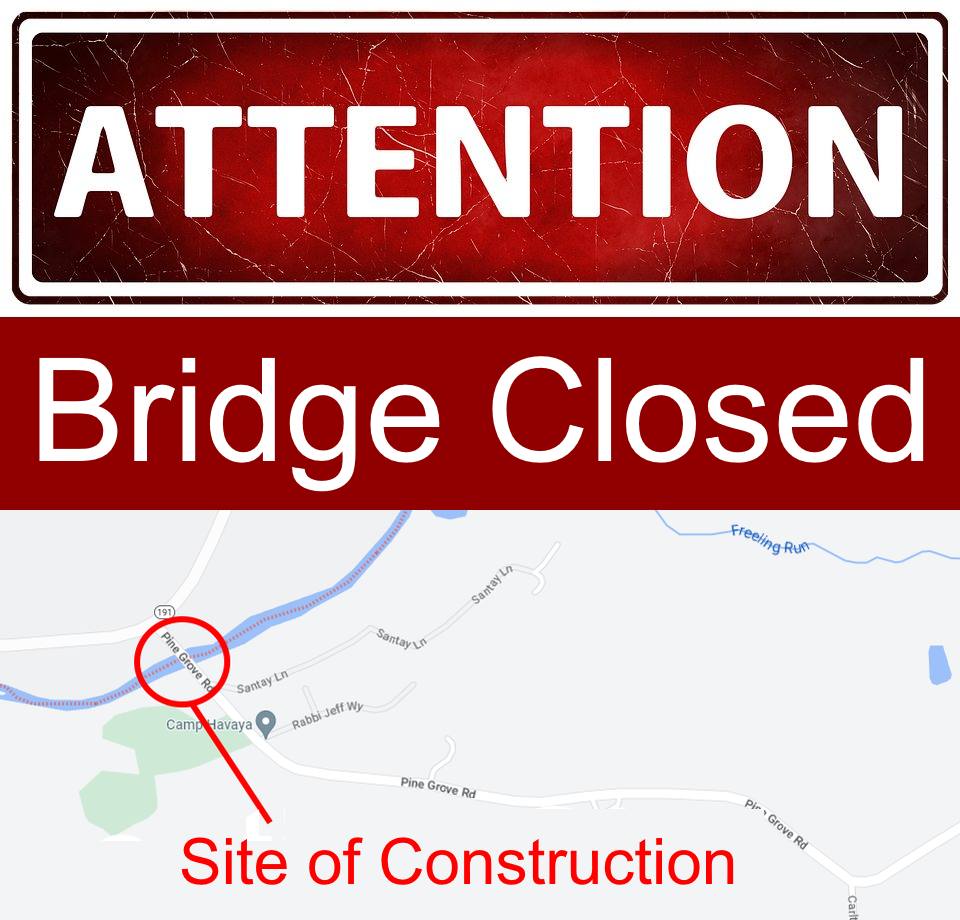
 Pine Grove Road bridge over Wallenpaupack Creek, near Rt 191 will be CLOSED, starting March 23, 2023 through August 2023 for a bridge repair project.
  For more information, visit PennDOT’s Projects website: